A crowded event floor gives people seconds to decide where to look, where to walk, and who to talk to. The best signage types for events do more than fill empty space with a logo. They direct traffic, answer questions before staff members have to, and make your business look prepared, credible, and worth remembering.
For a trade show, community festival, open house, conference, or company gathering, the right signage plan depends on the venue, audience, and goal. A high-traffic exhibit hall needs attention-grabbing displays from a distance. A multi-room conference needs clear wayfinding. An outdoor event needs materials that can handle wind, weather, and repeated setup.
The goal is not to order every sign available. It is to choose the pieces that work together, carry one consistent brand message, and make it easier for people to take the next step.
Start With What Your Event Signage Must Do
Before choosing sizes, materials, or display hardware, define the job each sign needs to perform. Event signage generally falls into three categories: attracting attention, guiding people, and prompting action.
Attraction signage helps attendees find your booth, table, sponsor area, or storefront. Guidance signage reduces confusion around entrances, registration, parking, meeting rooms, and restrooms. Action signage gives visitors a clear reason to scan a code, pick up a brochure, request a quote, schedule a consultation, or speak with your team.
When one sign tries to do all three jobs, it often becomes too busy to read. A large banner should make your company and primary benefit obvious. A smaller tabletop sign can explain an offer. Directional signs should focus on location, not a long sales message.
Best Signage Types for Events and Where They Work
Retractable Banners for Booths and Entrances
Retractable banners are one of the most useful event assets because they are portable, professional, and quick to set up. They work especially well at trade shows, networking events, job fairs, conferences, and indoor vendor markets.
Use them for a concise message: what you do, who you help, and why someone should stop. A logo alone builds awareness, but a clear benefit gives attendees a reason to engage. For example, a lender might highlight fast local guidance, while a contractor might feature the type of project they specialize in.
A common mistake is placing too much copy on a banner. People should understand the main message from several feet away. Keep detailed service descriptions on handouts, screens, or follow-up materials.
Step-and-Repeat Backdrops for Photos and Visibility
Step-and-repeat backdrops place your logo or sponsor marks in a repeating pattern behind speakers, guests, award recipients, and event photos. They are a strong choice for grand openings, fundraisers, recognition events, product launches, and company celebrations.
Their value extends beyond the event itself. Every photo shared by attendees, sponsors, or local media can carry your brand into social feeds, newsletters, and future marketing materials. The trade-off is that the design must remain clean. Small logos, weak contrast, or overly detailed patterns can disappear in photos.
If multiple sponsors are involved, establish logo sizes, spacing, and brand rules before production. This prevents last-minute edits and ensures every organization receives the visibility it was promised.
Feather Flags and Outdoor Banners for Distance
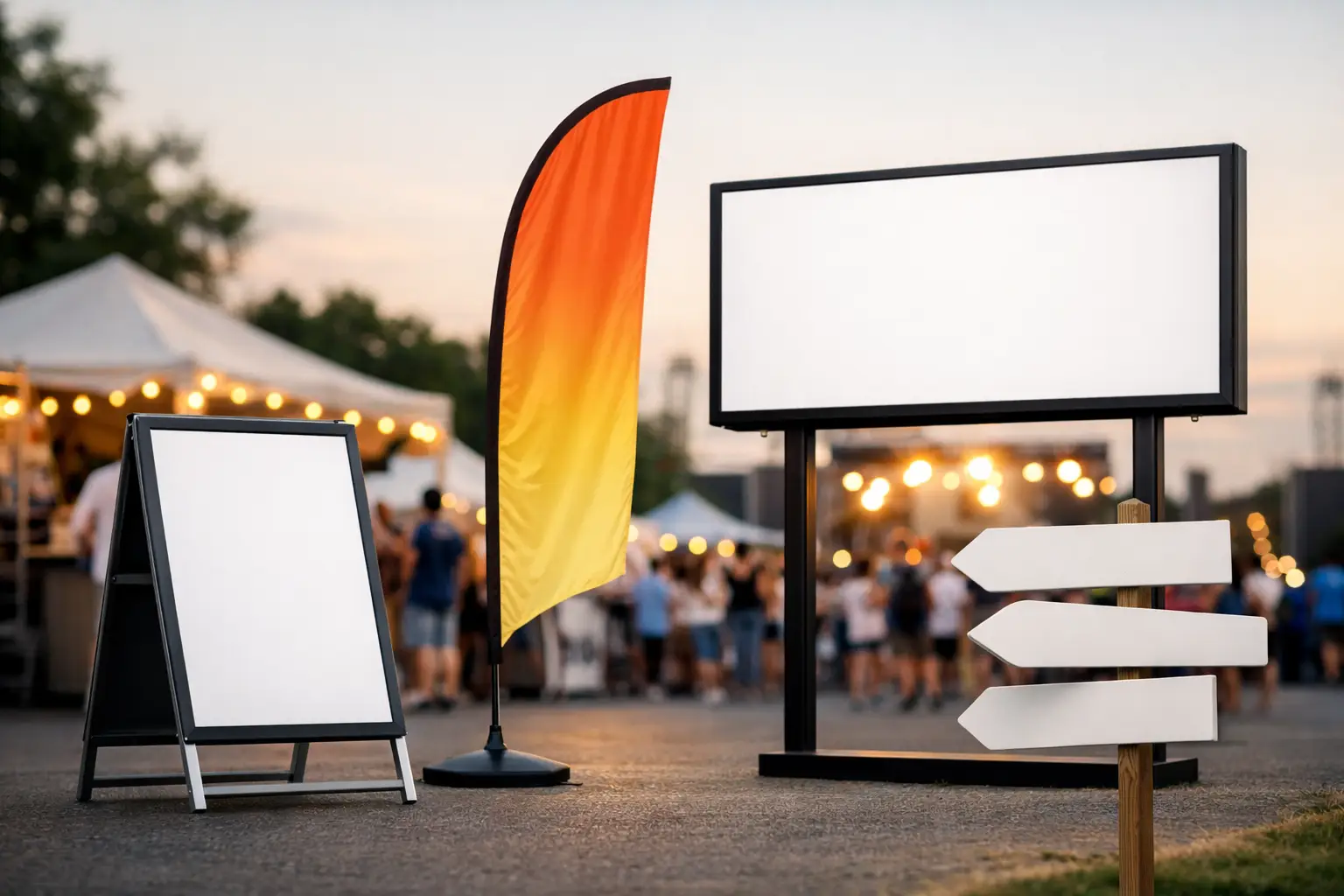
For outdoor events, feather flags and large vinyl banners are hard to beat for visibility. They can mark entrances, line walkways, identify vendor areas, promote special offers, or draw attention to a business location near an event.
Feather flags are ideal when movement and height can help catch the eye. They work well for car dealerships, real estate open houses, community events, retail promotions, and outdoor festivals. Large banners are better for fences, tents, stages, building fronts, and sponsor recognition.
Outdoor signage needs practical planning. Choose durable materials, proper hardware, and installation methods that fit the site. A sign that looks great in a proof but twists in the wind or cannot be securely displayed will not do its job.
Directional Signs That Reduce Confusion
Good wayfinding is rarely flashy, but it has a major impact on the attendee experience. Directional signs help guests find registration, parking, check-in, presentation rooms, food areas, restrooms, exits, and booths.
For larger events, use consistent colors, arrows, typefaces, and naming conventions across every directional piece. If the program says “Main Hall,” the sign should not call it “Conference Room A.” Small inconsistencies create unnecessary questions, missed sessions, and frustrated guests.
Yard signs, rigid signs on stakes, easel signs, and floor decals can all serve this purpose. The right choice depends on the venue and whether signage must be moved throughout the day.
Tabletop Signs for Conversations and Offers
Tabletop signs are small, but they are valuable in places where people pause: registration tables, restaurant counters, networking tables, product demos, information stations, and exhibitor booths. They can highlight pricing, event-only promotions, QR codes, service packages, giveaway instructions, or appointment options.
These signs work best when they support a conversation rather than replace one. A tabletop sign can answer the first question and give your staff a natural opening: “Are you looking for that service now, or planning ahead?”
Use sturdy holders and readable type. A polished message printed on flimsy material can weaken the professional impression you worked to create.
Floor Graphics for Guided Traffic
Floor graphics turn unused walking space into a practical branding and navigation tool. They can lead guests toward registration, point visitors to an exhibit, create a path for a product experience, or reinforce a campaign message.
They are especially effective in large indoor venues where wall space is limited. However, they must be installed on suitable surfaces and positioned where they will not create a safety issue. Keep the message simple because people read floor graphics while moving.
Window, Wall, and Vehicle Graphics for Extended Reach
Events often create opportunities beyond the booth itself. Window graphics can promote an in-store event. Wall graphics can transform a venue entrance or branded photo area. Vehicle graphics can identify a mobile team, delivery vehicle, or event activation before guests even arrive.
These options are particularly useful when your event is part of a larger campaign. Instead of treating signage as a one-day expense, choose pieces that can continue supporting local visibility after the event is over.
Design for Fast Reading, Not Just Good Looks
A sign can use the correct logo and brand colors yet still fail because the message is hard to absorb. Event attendees are distracted. They are talking, walking, checking schedules, and looking at competing displays. Your signage needs to communicate quickly.
Lead with the most important idea. Use high contrast between text and background. Keep type large enough for the viewing distance, and avoid placing critical copy too low, where tables, crowds, or display stands can block it. A clean hierarchy matters more than decorative effects.
Consistency also builds trust. Your banner, brochures, business cards, giveaway items, and landing page should feel like they belong to the same company. Mixed logos, off-brand colors, and different messaging make even a capable business appear disorganized.
Plan Production Before the Event Gets Close
Last-minute signage creates avoidable headaches: rushed design decisions, limited material choices, production errors, and expensive shipping. Start by reviewing the venue rules, booth dimensions, display restrictions, installation options, and delivery deadlines.
Think about the full attendee journey. What will guests see from the parking lot? What will help them find check-in? What will make them notice your space? What will they take with them after a conversation? This approach helps you invest in signage that supports real business goals instead of ordering isolated pieces.
A reliable branding and print partner can simplify this process by coordinating design, print materials, displays, promotional products, and digital campaign assets under one brand standard. That means fewer vendors to manage and fewer opportunities for a color, message, or logo detail to go wrong.
The strongest event signage makes people feel that your business has thought ahead. When guests can find their way, understand your value, and remember how to reach you, your signs keep working long after the event floor clears.