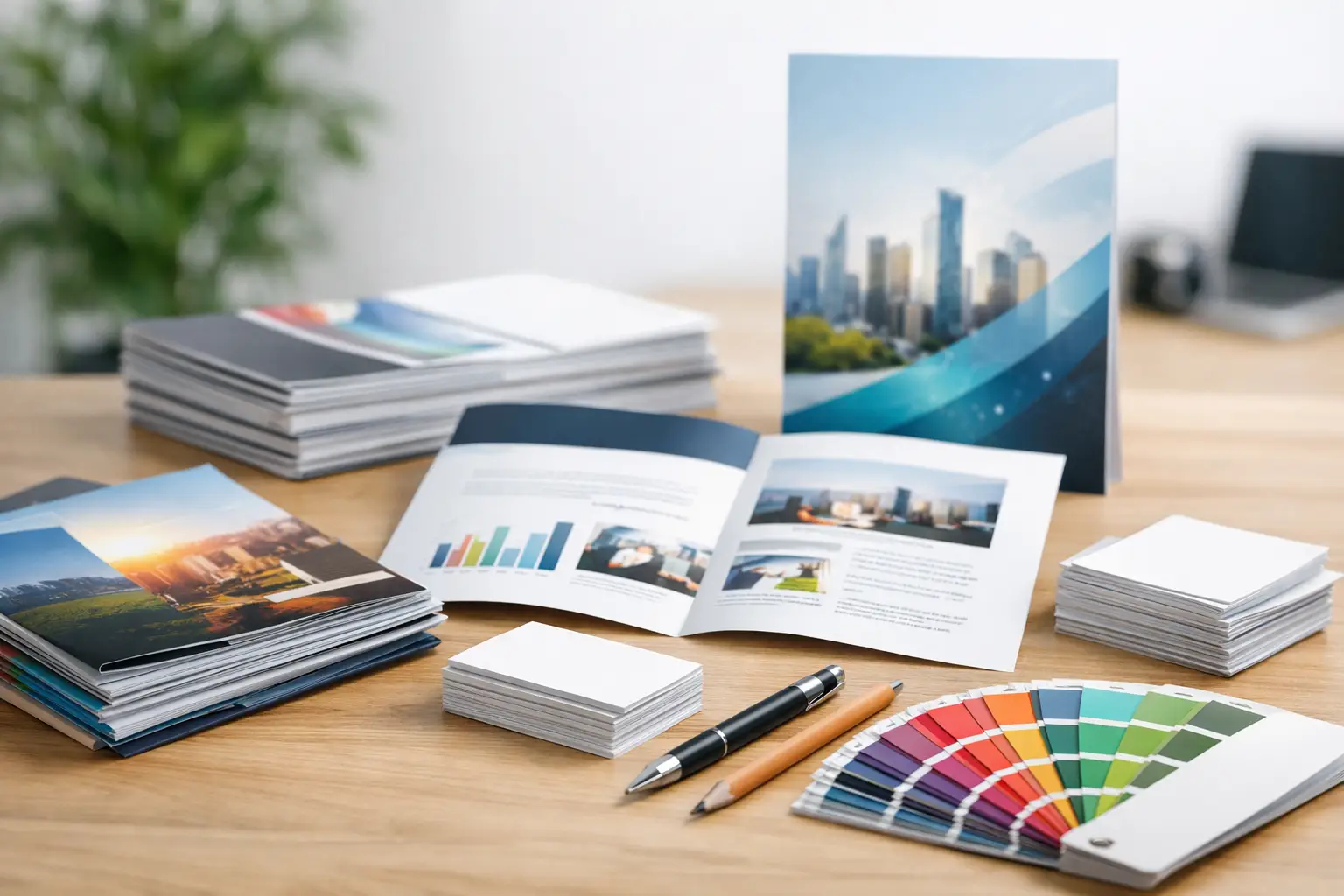
A business card with the wrong phone number. A flyer that looks nothing like your website. A trade show banner that arrives in the wrong size. Most print problems are not design problems – they are coordination problems. This print marketing materials guide is built to help small and mid-sized businesses choose the right pieces, keep branding consistent, and avoid the mistakes that waste time, money, and opportunities.
Print still matters because people keep it, share it, and remember it differently than a digital ad. A strong printed piece can add credibility in seconds. It can also make your business look disorganized just as fast if the message, design, or quality is off. That is why the best print strategy is not about ordering more items. It is about choosing the right materials for the way you sell.
What a print marketing materials guide should actually help you do
Most companies do not need every printed product available. They need the right mix for their sales process. A local service company may need door hangers, vehicle graphics, and leave-behind flyers. A real estate team may need postcards, listing packets, open house materials, and signage. A B2B company may get more value from presentation folders, brochures, and trade show displays than from mass mail pieces.
The point is simple. Print works best when it supports a specific business action. That action might be getting a call, reinforcing a sales meeting, driving foot traffic, or making your team look more established. If the material does not support a real step in your customer journey, it is probably just extra inventory.
Start with the materials that carry the most weight
If your brand foundation is weak, adding more printed pieces will not fix it. Start with the materials customers see most often and the pieces your team uses every week.
Business cards
Business cards still matter, especially in service businesses, networking, real estate, lending, construction, and local B2B sales. They are small, but they do a big job. A good card should feel intentional, easy to read, and clearly connected to the rest of your brand.
This is not the place to cram in every service you offer. Focus on your name, role, company, contact details, and a clean visual identity. Better paper stock can help, but clarity matters more than fancy finishes. If the design is cluttered or the logo is weak, upgraded paper will not save it.
Flyers and sell sheets
Flyers are useful when you need a fast, flexible handout for promotions, events, local outreach, or service overviews. Sell sheets are often better when your sales team needs a cleaner one-page piece to support conversations.
The trade-off is attention span. A flyer can handle more visual energy for a promotion. A sell sheet should feel more focused and polished. If you use either one, make sure the headline says something meaningful fast. People should know what you do and why it matters without hunting for the point.
Brochures
Brochures make sense when your offer needs more explanation. They work well for companies with multiple services, industries, packages, or a more consultative sales process. They also help when you need a leave-behind that feels more substantial than a flyer.
That said, brochures are easy to overbuild. If your services change often, you may end up reprinting too frequently. In those cases, a flexible flyer or a shorter capabilities sheet may save money and reduce waste.
Postcards and direct mail pieces
Postcards are practical because they are simple, visible, and cost-effective for local campaigns. They can promote offers, announce openings, stay in front of past customers, or target neighborhoods around a service area.
The challenge is discipline. Direct mail only works when the message is clear, the list is solid, and the design gets to the point quickly. If you treat a postcard like a mini brochure, response usually drops.
Signage and trade show materials
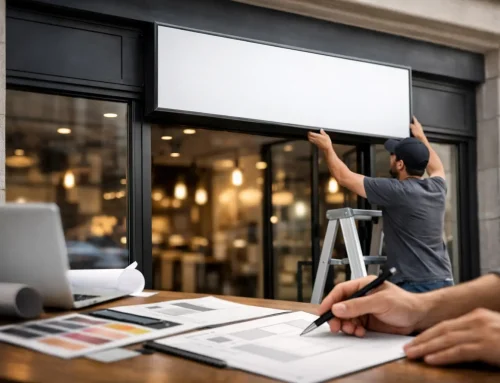
Signs, banners, table covers, backdrops, and display materials do heavy lifting in person. They shape first impressions before a conversation even starts. For trade shows, conferences, retail spaces, and events, these are often your biggest visual assets.
Here, sizing and production details matter as much as design. A great layout can fail if the file is built incorrectly for the final format. This is one reason businesses often benefit from working with a single partner who understands both design and production requirements.
How to choose the right print pieces for your business
A practical print marketing materials guide should help you prioritize, not overwhelm you. Start by asking three questions.
First, where do leads actually come from? If your business grows through referrals and local networking, business cards and branded leave-behinds may outperform a large direct mail run. If you rely on geographic targeting, postcards and door hangers may be the smarter investment.
Second, what does your sales process require? If customers need education before they buy, brochures, presentation folders, or printed packets may help close deals. If the buying decision is fast, simpler pieces with one clear message usually work better.
Third, where is your brand currently inconsistent? Many companies already have enough print materials. The problem is that nothing matches. Different logos, different colors, outdated taglines, and mixed quality create friction. Fixing inconsistency often improves results more than adding a new item.
The common print mistakes that cost businesses money
Most wasted print spend comes from avoidable issues.
One of the biggest is designing in isolation. Your postcard should not feel like it came from one company while your website and business card came from another. Customers notice when branding shifts from piece to piece, even if they cannot explain why.
Another common mistake is ordering before the messaging is settled. If your offer, contact details, or service list is still changing, pause the print run. It is cheaper to wait than to reprint.
There is also the temptation to choose only by unit price. Lower-cost printing can be fine for some jobs, but not for every job. A short-term event flyer has different quality requirements than a premium brochure for high-value prospects. Smart print decisions balance budget, use case, and brand image.
Finally, businesses often skip proofing details because they are in a hurry. Phone numbers, email addresses, QR codes, mailing panels, trim areas, folds, and bleed settings all need attention. Small errors become expensive fast once something is on press.
Why consistency matters more than volume
You do not need a huge library of printed materials to look established. You need a small set of pieces that work together. When your business card, brochure, signage, website, and promotional items all share the same visual language, your company feels more credible. Customers trust what looks organized.
This matters even more for growing businesses that do not have an in-house marketing department. If different vendors handle design, print, signage, and web updates separately, brand drift usually shows up over time. Colors shift. Logos get stretched. Messaging changes. The result is more back-and-forth, more mistakes, and more cost than expected.
That is why many companies prefer to centralize creative and production. It simplifies approvals, reduces handoff errors, and makes it easier to keep every piece aligned. For businesses that want fewer headaches and cleaner execution, that operational benefit is just as valuable as the design itself.
A simple way to build your print toolkit
If you are not sure where to start, build in phases. Begin with the essentials your team uses now, then add pieces that support your next sales goal.
For many businesses, phase one means business cards, a core flyer or sell sheet, and one strong sign or display item if you meet customers in person. Phase two may include postcards, brochures, presentation folders, or event materials. Phase three might expand into branded promotional products, apparel, or larger campaign support.
That approach keeps your print budget tied to actual business needs. It also gives you time to test what gets used, what gets ignored, and what needs to be updated before you over-order.
A print marketing materials guide works best when print is part of the bigger brand
Print should not stand alone. It should support your website, your sales conversations, your follow-up process, and your overall market presence. The best printed pieces do not just look good on a desk. They help move someone one step closer to contacting you, remembering you, or trusting you enough to buy.
That is the real goal. Not more stuff. Better alignment.
If your current materials feel scattered, outdated, or harder to manage than they should be, start smaller than you think. Clean up the essentials, make them consistent, and build from there. A well-chosen printed piece can do a lot of work when it clearly reflects who you are and makes it easier for customers to say yes.